iOS App
  Android App
 Study tips
The Hypercorrection Effect: Check Answers You Were Sure About
Piply Team
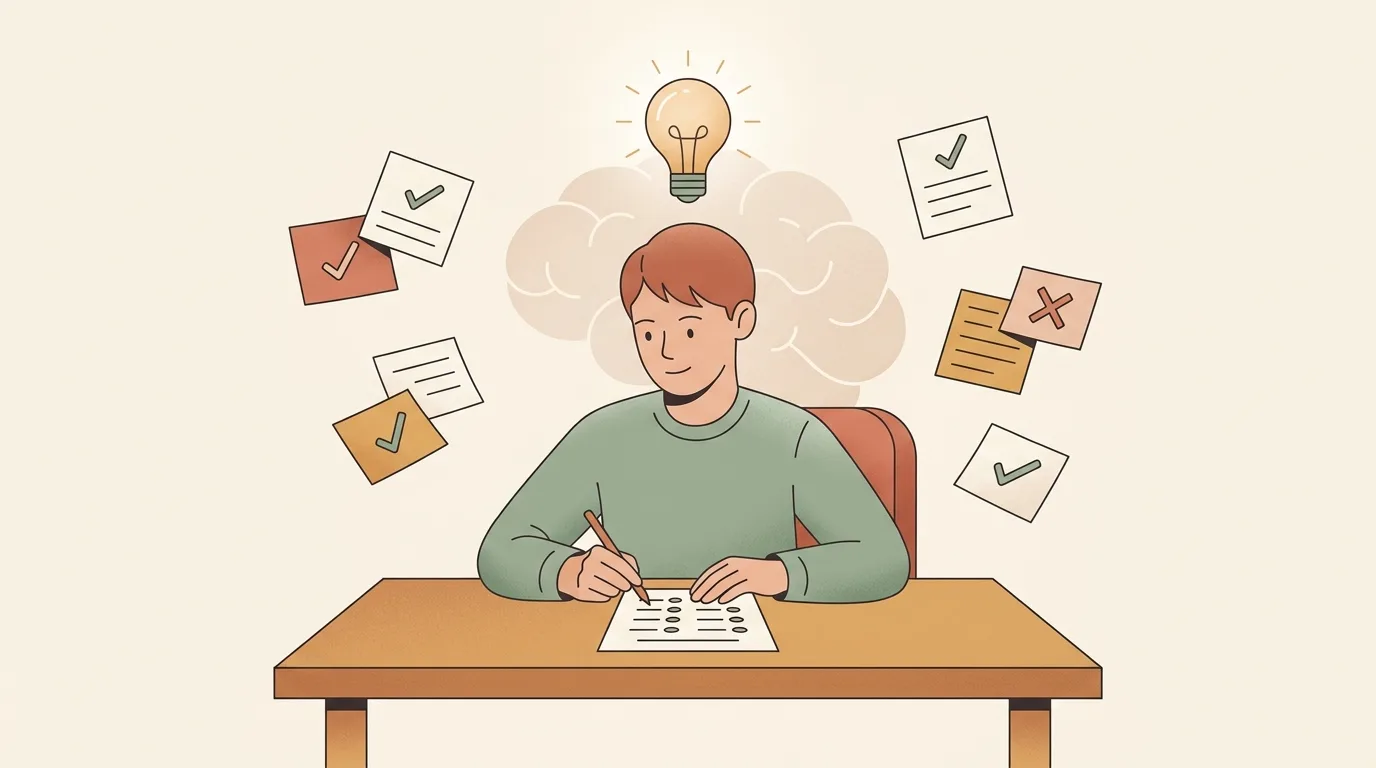
Confidence and difficulty are different
A confidently wrong answer is one you believed was correct before checking it. It can happen on a question that seems easy. A difficult question may instead leave you uncertain. Hypercorrection concerns confidence in an error, rather than how hard the question feels.
Use a surprising correction to examine your reasoning, but also review mistakes you were unsure about. Neither confidence nor frustration tells you whether learning has occurred.
What the studies show
Butterfield and Metcalfe's 2001 study found that errors on general-information questions made with higher confidence were more likely to be corrected on a subsequent test after correct-answer feedback. That is a relative finding, not a promise that every confident error will disappear or that low-confidence errors cannot be learned from.
A 2006 study by the same researchers used a concurrent tone-detection task during feedback. Its results supported an explanation involving greater attention to corrections of high-confidence errors. They do not establish that annoyance itself is learning or that every learner experiences the same response.
Metcalfe and Miele's 2014 experiment studied general-information answers among college students. Testing some corrected errors again immediately improved recall at a later test, conducted 7–14 days afterward, and reduced the return of original errors. This supports checking corrections again in that setting; it does not prescribe a universal review interval or guarantee permanent retention.
Check the answer and its reasoning
- Try a relevant practice question before checking the answer. If useful, record whether you are unsure or confident; an invented confidence score is unnecessary.
- Compare your answer with a reliable solution or explanation. Identify the fact, step or assumption that needs correction, and ask for help if the reasoning remains unclear.
- Record what to practise again. Include uncertain mistakes and knowledge gaps as well as confident errors, according to what you need to learn.
- Return to the question without the answer in view. Check your response again and try an application problem when understanding or use of the idea matters.
For example, if you confuse two biological processes, compare their stages and outputs with your course material, then explain the distinction yourself. A memorable surprise is a starting point for that work, not proof you will remember it weeks later. You do not need to manufacture errors or distress to practise.
Use Piply for checked practice
If Piply generates a question or explanation, compare it with the original source before relying on it. Keep a note of corrections and topics to revisit. A correct response to one generated question cannot establish lasting understanding or performance on other tasks.
Put the ideas into practice
Use Piply to organize materials and practise what you’re learning.
Try Piply